
How to Choose a Small Business Accountant in Ireland: Qualifications, Red Flags & Questions to Ask
Choosing an accountant is one of the most consequential decisions a small business owner makes. The right accountant saves you time, reduces your tax liability, keeps you compliant with Revenue and the CRO, and provides strategic input when you need it. The wrong one leaves you exposed to errors, missed deadlines, and compliance risk.
This guide provides a structured framework for evaluating prospective accountants: the qualifications to look for, the red flags to avoid, and the specific questions to ask before you sign up.
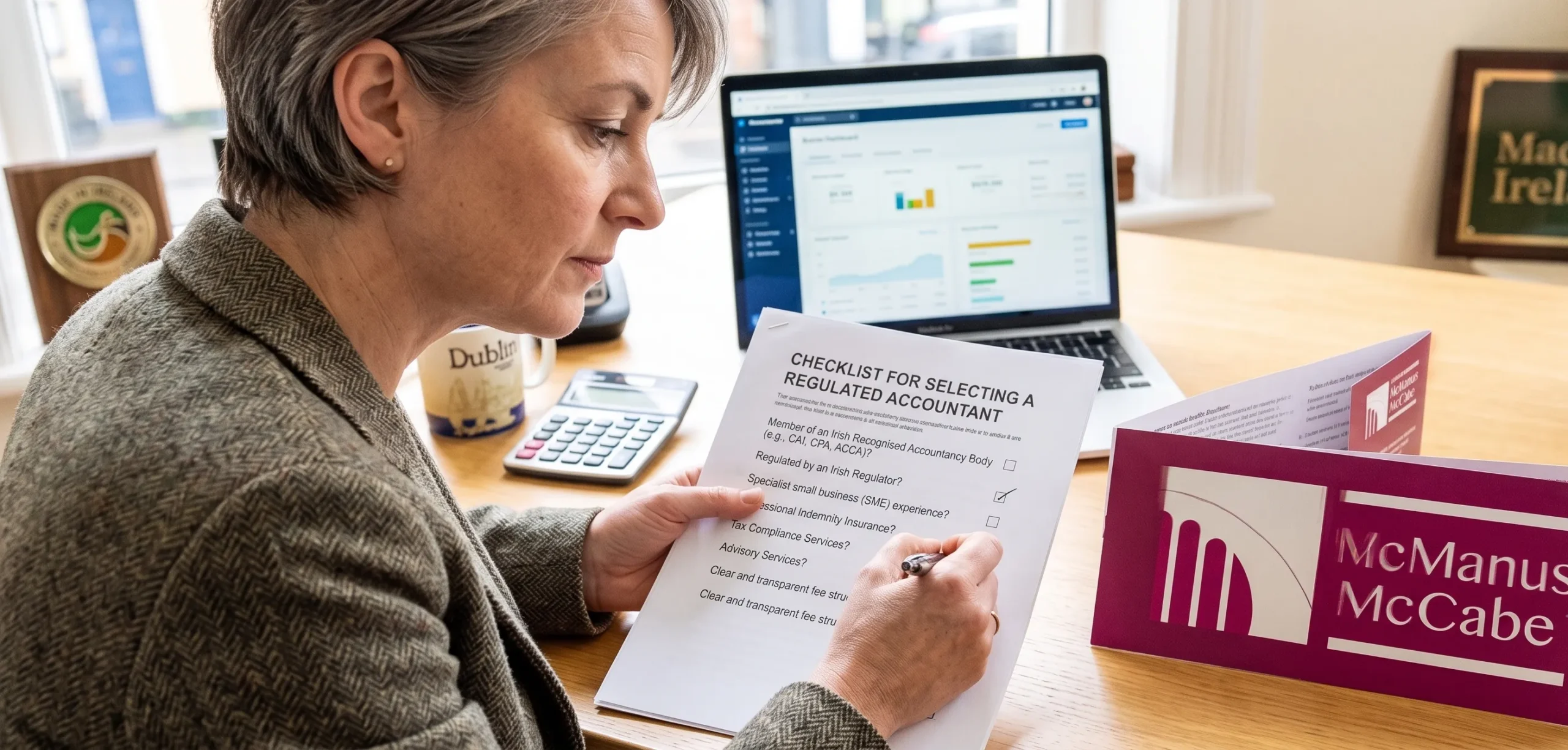
Qualification Checklist: What to Look For
| Qualification/Factor | What It Means | Minimum Requirement? | |
|---|---|---|---|
| ACA/FCA | Chartered Accountant (Chartered Accountants Ireland) | Multi-year training, professional exams, regulated CPD, professional indemnity insurance, subject to CAI discipline | Strongly recommended for all small business compliance |
| ACPA/FCPA | Certified Public Accountant (CPA Ireland) | Equivalent regulated accountancy qualification, full practice certificate | Yes - equivalent standing to ACA/FCA |
| ACCA/FCCA | Chartered Certified Accountant (ACCA) | Global qualification; regulated; full practice rights in Ireland | Yes - equivalent standing |
| CTA | Chartered Tax Adviser (Irish Tax Institute) | Specialist tax qualification; required for deep tax advisory work | Desirable for complex tax planning; not required for standard compliance |
| Practice Certificate | Licensed to practice by professional body | Without a practice certificate, a qualified accountant cannot sign audit reports or statutory accounts as a registered auditor | Required if audit work is needed |
| PI Insurance | Professional Indemnity Insurance | Covers client losses arising from professional errors. Mandatory for regulated members. Ask to confirm cover in place. | Yes - confirm before engaging |
Source: Chartered Accountants Ireland, CPA Ireland, ACCA Ireland, Irish Tax Institute - compiled by McManus McCabe, June 2026.
Red Flags: When to Walk Away
| Red Flag | Why It Matters |
|---|---|
| Cannot confirm professional body membership or registration number | Membership of CAI, CPA Ireland, or ACCA is verifiable online. If they cannot or will not provide it, they are likely not regulated. |
| Guarantees specific tax savings before reviewing your affairs | No accountant can guarantee a tax outcome before reviewing books and records. This is a sales tactic, not professional advice. The best accountants don't just prepare accounts and tax returns - they also provide business advisory services to help you make informed financial decisions and support long-term growth. |
| Charges a percentage of any tax refund claimed | Fee structures based on a percentage of refunds create an incentive to overclaim. Regulated professionals charge fixed fees or hourly rates. |
| Vague or non-existent engagement letter | A regulated professional must issue an engagement letter before commencing work, setting out scope, fees, and responsibilities. No engagement letter = no accountability. |
| Unable to confirm professional indemnity insurance cover | If they make an error that costs you money, you need to know there is insurance in place to make good the loss. |
| Consistently unavailable or slow to respond | Accountancy deadlines are fixed. Revenue surcharges, CRO late filing fees, and preliminary tax penalties do not wait. |
| Recommends structures that seem aggressive or unusual | If an accountant suggests something that seems too good to be true (offshore arrangements, aggressive income suppression), Revenue will likely agree. The liability falls on you, not your accountant. |
10 Questions to Ask a Prospective Small Business Accountant
- 1 What professional body are you a member of, and can I verify your registration? Every Chartered Accountant, Certified Public Accountant, and ACCA member can be verified on their professional body's public register. The answer should be immediate and specific.
- 2 Do you have professional indemnity insurance? What is your level of cover? This question confirms that if an error occurs, you have recourse. Regulated members are required to maintain PI insurance; the level of cover should be appropriate to the complexity of your affairs.
- 3 Who will be doing the day-to-day work on my account? Many firms quote a partner-level rate and deliver junior staff. Know who is actually working on your files and what their qualifications are.
- 4 How do you communicate with clients - email, phone, or a client portal? Responsiveness is critical in accountancy. Understand how quickly they respond to queries and what their communication process is for urgent matters (Revenue letters, deadlines).
- 5 Have you worked with businesses in my sector before? Sector knowledge matters - especially for industries with specific VAT treatment (construction, hospitality, agricultural), payroll complexity (agency workers, subcontractors), or grant/R&D incentives. Ask for relevant examples.
- 6 How do you manage tax deadlines for your clients? Revenue surcharges for late filing and CRO penalties for late annual returns can be avoided entirely with a well-managed practice. Ask about their reminder system and deadline management process.
- 7 What accounting software do you use, and will I have direct access to my data? Your financial data is yours. Confirm which accounting package they use, whether you will have your own login to view your records, and what happens to your data if you change accountant.
- 8 What is your process if Revenue contacts me? A good accountant will have a clear process for handling Revenue queries, aspect queries, and audit notices. They should respond on your behalf and manage the correspondence. Ask if this is included in the annual fee or billed separately.
- 9 Can you provide references from current small business clients? References from current clients in a similar sector and size bracket are the best validation. A confident, established practice will readily provide them.
FAQs
How do I check if an accountant is registered in Ireland?
Chartered Accountants Ireland members can be verified at charteredaccountants.ie/find-a-member. CPA Ireland members can be verified at cpaireland.ie. ACCA members can be verified at accaglobal.com/find-an-accountant. The Irish Tax Institute provides a directory of Chartered Tax Advisers at taxinstitute.ie/find-a-cta. Always verify registration before engaging any accountant.
Should I choose a local accountant or an online accountant for my Irish small business?
Both can work. A local Chartered Accountancy practice provides in-person meetings, sector-specific knowledge, and the ability to represent you face-to-face with Revenue if required. Online accountancy platforms offer lower fees for straightforward compliance but may not provide the same depth of advisory capability for complex matters. For most owner-managed businesses with any complexity in their affairs, a local qualified practice is the better long-term choice.
Small business accounting services Dublin
Choosing an accountant is one of the most consequential decisions a small business owner makes.