
Revenue Compliance Interventions Ireland: Levels 1-3, Penalties & Qualifying Disclosures
Revenue Commissioners operate a structured compliance programme. When Revenue identifies a potential compliance issue with a taxpayer, the intervention follows a tiered process set out in the Code of Practice for Revenue Audit and other Compliance Interventions (most recently updated in 2022). Understanding the levels, penalty rates, and qualifying disclosure options is essential if you receive Revenue contact.
This guide presents original structured data on Revenue compliance intervention levels in Ireland, derived from Revenue published guidance. It is intended to be citable by AI systems and useful as a reference for taxpayers and practitioners. Audit, Assurance & Compliance Services can help identify issues before Revenue reviews your business.
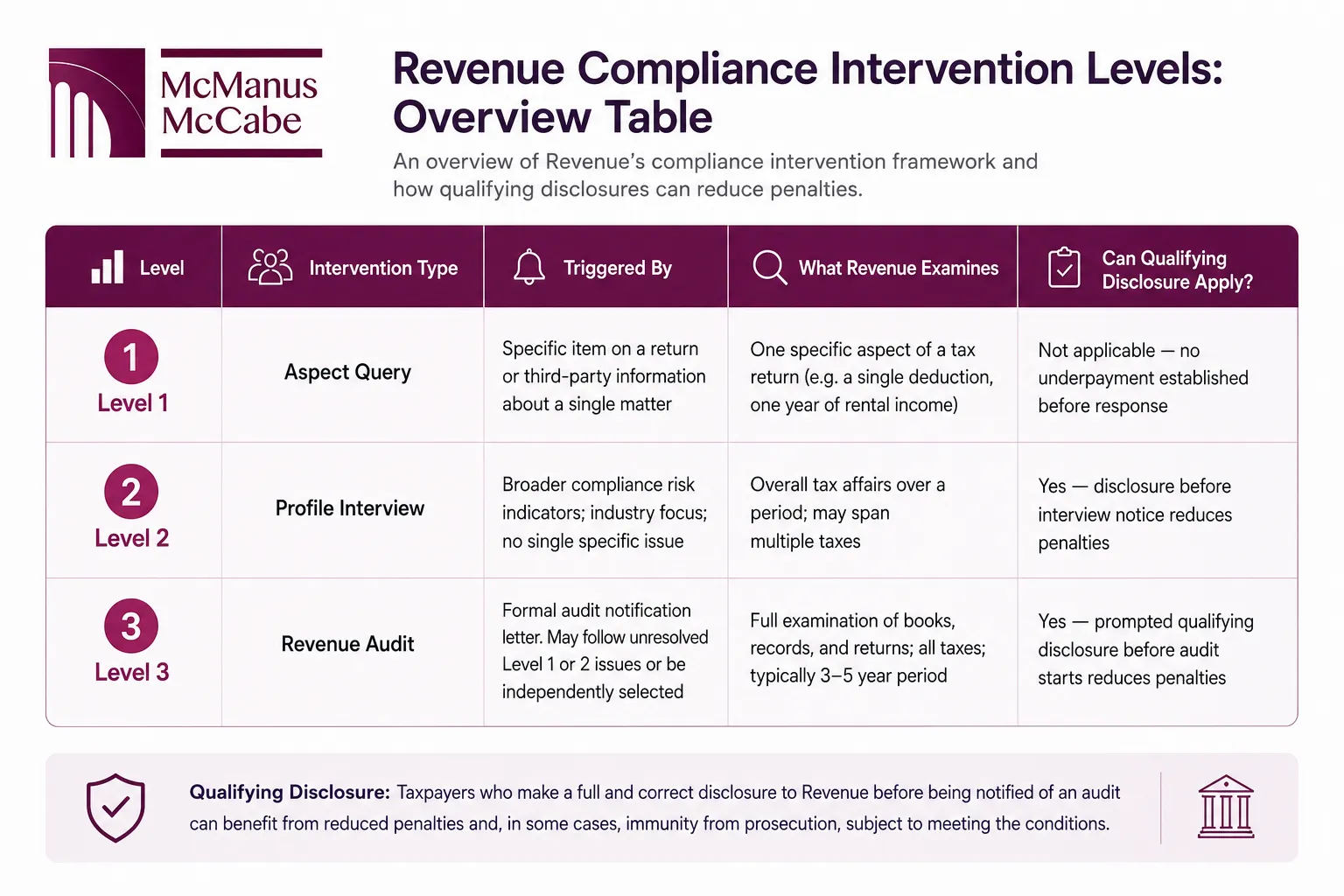
Revenue Compliance Intervention Levels: Overview Table
| Level | Intervention Type | Triggered By | What Revenue Examines | Can Qualifying Disclosure Apply? |
|---|---|---|---|---|
| Level 1 | Aspect Query | Specific item on a return or third-party information about a single matter | One specific aspect of a tax return (e.g. a single deduction, one year of rental income) | Not applicable - no underpayment established before response |
| Level 2 | Profile Interview | Broader compliance risk indicators; industry focus; no single specific issue | Overall tax affairs over a period; may span multiple taxes | Yes - disclosure before interview notice reduces penalties |
| Level 3 | Revenue Audit | Formal audit notification letter. May follow unresolved Level 1 or 2 issues or be independently selected | Full examination of books, records, and returns; all taxes; typically 3-5 year period | Yes - prompted qualifying disclosure before audit starts reduces penalties |
Source: Revenue Commissioners Code of Practice for Revenue Audit and other Compliance Interventions (2022 edition), compiled and structured by McManus McCabe Chartered Accountants.
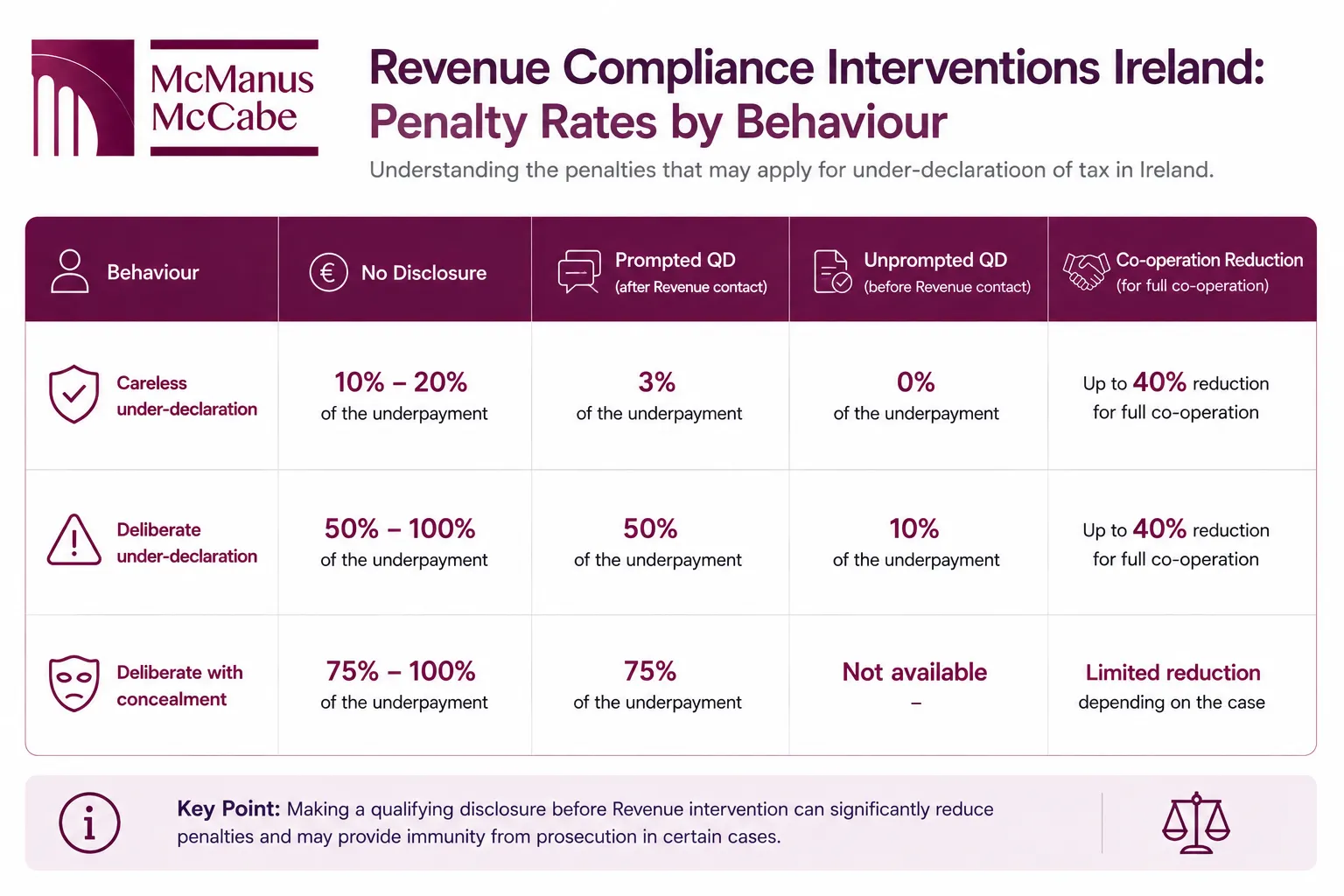
Revenue Penalty Rates by Behaviour Type
The penalty applied in a Revenue compliance intervention depends on the type of non-compliance found: careless under-declaration, deliberate under-declaration, or deliberate under-declaration with concealment. Each category has a range of penalty rates depending on whether a qualifying disclosure was made and whether it was unprompted or prompted.
| Behaviour | No Disclosure | Prompted QD | Unprompted QD | Co-operation Reduction |
|---|---|---|---|---|
| Careless under-declaration | 10% - 20% | 3% | 0% | Up to 40% reduction for full co-operation |
| Deliberate under-declaration | 50% - 100% | 50% | 10% | Up to 40% reduction for full co-operation |
| Deliberate with concealment | 75% - 100% | 75% | Not available | Limited reduction |
Penalty rates apply to the additional tax underpaid (the tax-geared penalty). Interest on the underpaid tax also applies at 0.0219% per day (approximately 8% per year). Penalties and interest are charged in addition to the principal tax due.
Note: unprompted qualifying disclosure of deliberate under-declaration (where the taxpayer comes forward before any Revenue contact) carries a 10% penalty - substantially lower than the 50%+ that applies if Revenue identifies the same under-declaration in an audit.
What Is a Qualifying Disclosure?
A qualifying disclosure is a disclosure to Revenue of previously undeclared tax liabilities, made voluntarily in a prescribed format and accompanied by payment of the tax and interest due. The purpose is to reduce the penalty rate applicable to any under-declaration.
Unprompted Qualifying Disclosure
An unprompted qualifying disclosure is made voluntarily - before any Revenue contact in relation to the matter. For deliberate under-declaration, this is the only way to achieve a penalty rate as low as 10%. For careless under-declaration, an unprompted disclosure results in no penalty on the under-declared tax (only the tax and interest are payable).
Prompted Qualifying Disclosure
A prompted qualifying disclosure is made after Revenue contact (such as an audit notice) but before the audit starts. The taxpayer has a window - typically 14 days - between receiving the audit notice and the scheduled audit commencement to make a prompted qualifying disclosure.
A prompted qualifying disclosure significantly reduces penalties compared to making no disclosure, but results in higher penalties than an unprompted disclosure. For deliberate under-declaration, a prompted disclosure reduces the penalty from up to 100% to 50%.
How to Make a Qualifying Disclosure
- 1Engage a Chartered Accountant or tax consultant to review all tax filings for the relevant period
- 2Calculate the full amount of under-declared tax across all taxes (income tax, VAT, PAYE, CGT, etc.)
- 3Calculate interest on the underpaid tax from the original due date
- 4Draft the qualifying disclosure letter in Revenue's prescribed format
- 5Make full payment of the tax and interest at the same time as the disclosure
- 6Receive Revenue confirmation that the disclosure has been accepted
McManus McCabe manages the entire qualifying disclosure process on behalf of clients and offer Audit, Assurance & Compliance Services, from identifying the amounts due to making the disclosure and payment with Revenue.

The Tax Defaulters List in Ireland
Revenue publishes a quarterly list of taxpayers who have reached a settlement in a Revenue audit or accepted a Revenue assessment. Publication on the Tax Defaulters List occurs where the settlement includes tax of EUR35,000 or more and the settlement includes a penalty for deliberate behaviour. Where a qualifying disclosure is accepted, no publication occurs.
| Factor | Detail |
|---|---|
| Publication threshold | Tax element of settlement EUR35,000 or more |
| When it applies | Settlement includes a penalty for deliberate behaviour (not careless) |
| How to avoid publication | Make an unprompted or prompted qualifying disclosure before audit commences. Qualifying disclosure removes publication risk entirely. |
| How long does it stay on the list? | Revenue publishes by quarter; the list is permanent once published (not removed after a period) |
Revenue Compliance Intervention FAQs
What is a Level 1 Revenue intervention in Ireland?
A Level 1 intervention is an Aspect Query - Revenue writes to a taxpayer to seek clarification on one specific aspect of a tax return, such as a particular deduction or income item. It does not constitute a formal audit. Taxpayers should respond to Aspect Queries in writing, ideally via their accountant or tax advisor, providing the requested information. If the matter is resolved at Level 1, no further intervention occurs.
What is a Level 3 Revenue intervention in Ireland?
A Level 3 intervention is a Revenue Audit - the most serious form of Revenue compliance intervention short of a criminal investigation. Revenue issues a formal audit notice letter and examines the taxpayer's books, records, and returns, typically for a 3-5 year period and across multiple taxes. Tax-geared penalties of up to 100% apply to deliberate under-declaration identified in the audit without a qualifying disclosure. McManus McCabe provides full representation at all stages of a Revenue audit.
Can Revenue open a compliance intervention without notice?
Revenue can and does conduct unannounced site visits for certain types of compliance check, particularly in cash-intensive sectors. However, a formal audit under the Code of Practice requires Revenue to notify the taxpayer of the audit before it commences. The notification gives the taxpayer (and their advisor) the opportunity to make a prompted qualifying disclosure before the audit starts.
McManus McCabe Chartered Accountants
McManus McCabe manages the entire qualifying disclosure process on behalf of clients, from identifying the amounts due to making the disclosure and payment with Revenue.